Makery Glowstick Fashion

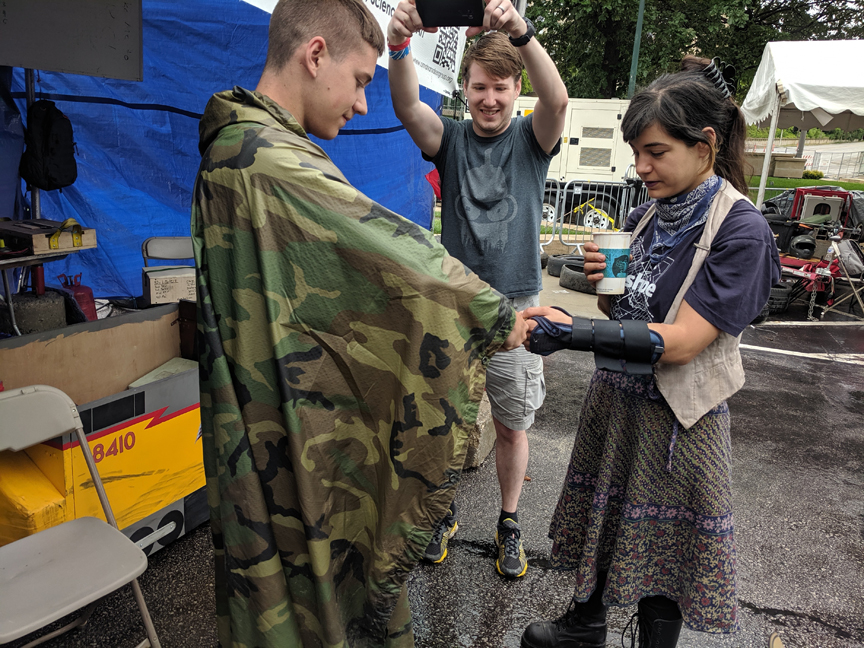
Myself and Brandon Essler put together a glowstick holster and a glowstick bracer at yesterday’s meeting, continuing the trend of glowy maker high fashion.

The plan is to eventually wire these pieces up with some sort of LED infusion.

You’ll be able to view these in action at this year’s “New Year Revolution” event.


Maker High Fashion…the EL Coat

Actually, I’ll leave the judgment as to whether this is fashionable to the reader.  Taking a cue from the ready availability of electroluminescent tape/wire to the Maker community, and yes, the recent Tron movie (which re imagined the cult classic costuming in a decidedly more modern twist), it has become too tempting to ignore the possibilities and shaking up the norm.

And so, using white EL tape from Adafruit, two AAA battery packs, a coat I rather like from H&M, and a bit of sewing, viola!  My Jeff Bridges impression is complete, man.

So, project aside, this has got me thinking about the state of change in fashion in the modern age.  Making a coat like this is one thing…how you use it quite another.  I think the Steampunk community must also face this problem.  When you think a certain fringe fashion is cool, do you wear it only among those who also share your (weird) tastes, or do you let that freak flag fly, hoping to inspire?  Let the social experiment begin!

What is this “Variac” Thing?

A Variac (also known as an Autotransformer) is a variable transformer, which allows the user a convenient way to control the power to an AC appliance.  In our context, it’s typically used to adjust the output of a heating device. The variac currently at the Makery is a 20-amp model manufactured by PowerStat.  We’ve configured it to scale voltage only in the down direction, so that the output range is 0-110vac (or whatever line voltage happens to be).  The transformer is outfitted with standard AC outlet fittings, and is mounted to a board for easy transport.  It should be noted that this transformer is NOT isolated, so the output could still be hazardous, regardless of how low the voltage happens to be set.  As with most other equipment, the variac is stored in the TOOLS cabinet.

TacitTheremin: A spatial awareness tool for the blind.

What’s this strange thing?  This is the TacitTheremin, a device which helps blind people understand their surroundings using ultrasonic sound ranging.  Designed to work in tandem with a cane, this device allows users to get a greater sense of what’s around them at ranges that exceed a cane and in any direction in which its pointed.

Inspired by the Tacit, an invention made by Grathio Labs, the TacitTheremin is a modification of that design concocted right here at the Omaha Maker Group.  It mounts to the wrist, receives distance measurements from an ultrasonic sensor, and outputs sound to the user through a speaker (low tones for far distances, high tones for short distances).  It ranges from 16 feet down to 3cm, 5 times per second.

See the original Tacit here.  The TacitTheremin is released under a Creative Commons BY-NC-SA License.

This whole project started as an attempt to replicate a Tacit (because the idea is just so darn cool), and in the end it turned out to look quite different, with different coding as well.  You can read about the epic journey in detail, and make your own for a friend (on an individual project basis).

But enough technical stuff.  See it in action!

Currently, this prototype is being field tested by a local Omahan named Mike, who happens to be blind.  Stay tuned for a followup video.

You can reach me with any comments, questions, or concerns here.  Just be sure and put “TacitTheremin” in the subject.  Alternatively, feel free to comment below!


The 3d Printers at Work

Its amazing what you can print these days. We tested out the Mendel Prusa last evening by printing this cool little light bulb sculpture.

If you could make any design in your head come to life, what would it be?

Much of what we can do these days with 3D printing is due to the hard work of Brandon.  Be sure and check out the new RepRap piece he’s making to ensure 3D printing just gets better and better: Vertical X-Axis

Be sure to check out our new “Makery Mendel” channel on Ustream, located in the links to the right.  Whenever the Makery is printing, you can see it happening.

One Month to Make: Nerf Gun Distance and Style Mod Competition

Are you a Maker?

The Omaha Maker Group is hosting a Nerf* dart gun competition for distance and visual improvement modification.

When: 7pm, November 9th

Where: The Makery

Competitors will modify a Nerf ‘N-Strike Nite Finder EX-3‘ to maximize it’s distance and/or aesthetic value.  Steampunks, artists, we look to you for inspiration.

The entrance fee for the competition is $10, but anyone can come and watch for free.

The gun may be modified in any way, provided that it remains at least somewhat identifiable as an N-Strike, and does not use pre-compressed air (such as CO2 cartridges) or chemical power. Electric power is permitted, provided the voltages are within reason (meaning the gun won’t cause a power outage).

Ammo will be standard-unmodified Nerf darts. For the contest each contestant will provide with their entry a minimum of three such darts in good condition (a new N-Strike comes with 3 darts), which will be pooled and used for the competition.

The modified weapon in ‘primed to fire’ condition must fit within a 3x7x11 inch container.

Performance for the distance competition will be measured by a maximum range test. The gun may be held by the contestant or mounted in a vice, provided the muzzle does not extend beyond the firing line. Distance will be measured from the firing line.

The cosmetic “Fine Weapon” competition will be judged by majority vote of your fellow participants.  The winner will be judged to have a very fine weapon indeed.   The winner will also gain a 10% distance bonus in that competition.

The winner of the distance competition gets bragging rights and a 1 month free membership to the Omaha Maker Group.


*’Nerf’ is descriptive of the brand of equipment to be used, and does not imply any other association with the brand.


The Mendel is Alive!!@!!

So, we have finally gotten the Makery Mendel to print properly. Yay.

So far we have printed a huge camera mount to make Kevin’s Camera and bike one. Also, a couple new gears and and linear bearing mounts to upgrade the ‘Bot.

We are in need of funding for more plastic. The roll of PLA that is on it is almost out. and a new spool will be about $65 plus shipping.

Here are some pics of stuff printed so far. :)

Convert old 35mm film camera lenses to work with digital SLRs

Zach sez:

This week I took a simple camera lens from a $3 film camera I got from a thrift store and attached it to a cheap Canon body cap after drilling a hole in it. The result was a bit surprising once it was attached to the camera. Since the lens gets so close to the sensor, it made an inexpensive macro lens.

Results:

Nice going!

Ozone Generator

OMG guru Dave K continues the Robot Arms project. But first, our hero must remove offensive odors...with SCIENCE! -Travis
____
I've found that the fat cables that came with the robot arm I got from the Makery are out-gassing a horrid stink of damp basement. Whelwick is starting to smell like an old barn. To address this I'm going to take a two phase approach. I'll need to address the source of the odor, the cables, and also, mostly for fun, I'll build an ozone generator to eradicate the airborn odor through oxidation of whatever fumes it's been putting in the air here.

To treat the cables I intend to soak them in bleach solution for a few days. Before I do this, I want to leave the ozone generator running for a while, to see how effective it is at neutralizing the odor causing particles.

The simplest way to generate ozone, at least for me, is to use the corona discharge method to convert atmospheric oxygen, O2 to ozone, O3. I'll be using a 12kV 30mA neon sign transformer. This operates at the line frequency of 60Hz, which isn't great for ozone production, but it does work. Another way to do this is to repurpose the flyback transformer from an old CRT (I have half a dozen if anyone needs such a device). The flyback can be driven from a simple 555 or microcontroller circuit to produce a high voltage, high frequency signal which is more effective than 60Hz for ozone production. It's also smaller.

To produce the corona discharge I'm going to try using conductive plates separated by an insulator. In this case, aluminum ductwork tape and glass. First I cut a bit of glass from a piece of scrap.


I then applied the tape to both sides and trimmed it clear of the edges to avoid arcing around the edges.


The corona discharge occurs at the edges of the plate, not where they overlap, so I want as much edge as I can get. Overlap provides capacitance, which for this application, I don't need or want, so I want a plate pattern with no overlap and plenty of edge. I went with an 'E' pattern. It's easy to cut.

I decided to use copper wire from a length of Romex 10/3 as connectors, so I could easily support the panel with the connectors. To maximize the contact area I made the wire long and gave it a right angle bend to prevent it twisting.


I secured the connectors with some Gorilla Tape (it was what was handy, and it's fun to use).


The corona panel is then connected to the transformer. For testing I've attached the neon sign transformer to a variable autotransformer so that I can start out at a low voltage and ramp up the output of the neon sign transformer. Too much voltage can puncture the glass dielectric, which will shatter the glass (another reason for the tape, to contain the glass). I don't think there is much danger of this, since I'm not reaching voltages where this should be a problem, but if there are flaws in the glass it is possible.

The wiring for the neon sign transformer also has a safety gap configured. The spacing of the gap is set so that any voltage much above the 12kV the transformer secondary is designed for will cause an arc across the safety gap to protect the transformer.


To verify that it is generating ozone, and just in case it bursts, I put a container over the corona panel until I ran it up to full voltage and let it sit for a while.


The corona is fairly faint unless your eyes are dark adapted. To get visualize it I've set the camera up for long exposure in the dark. My cameras are cheapie point-n-clicks, so you'll have to put up with the not-so-great quality. here it is from both sides.


Here's what happens if you up the voltage but forget to open up the safety gap.


From the corona images it is apparent that the sharp points of the 'E' pattern are producing a lot of corona (the shape of an electric field around sharp points encourage dielectric breakdown and corona discharge, this is why bulbous, polished surfaces are so popular in high voltage labs). If you look closely though, you can see that there is discharge along the edges as well, as was intended. I don't know which is better. Regardless, it generates enough ozone. The staticy odor of ozone is strong after running for a couple of seconds of running.

I guess that qualifies this as a success.